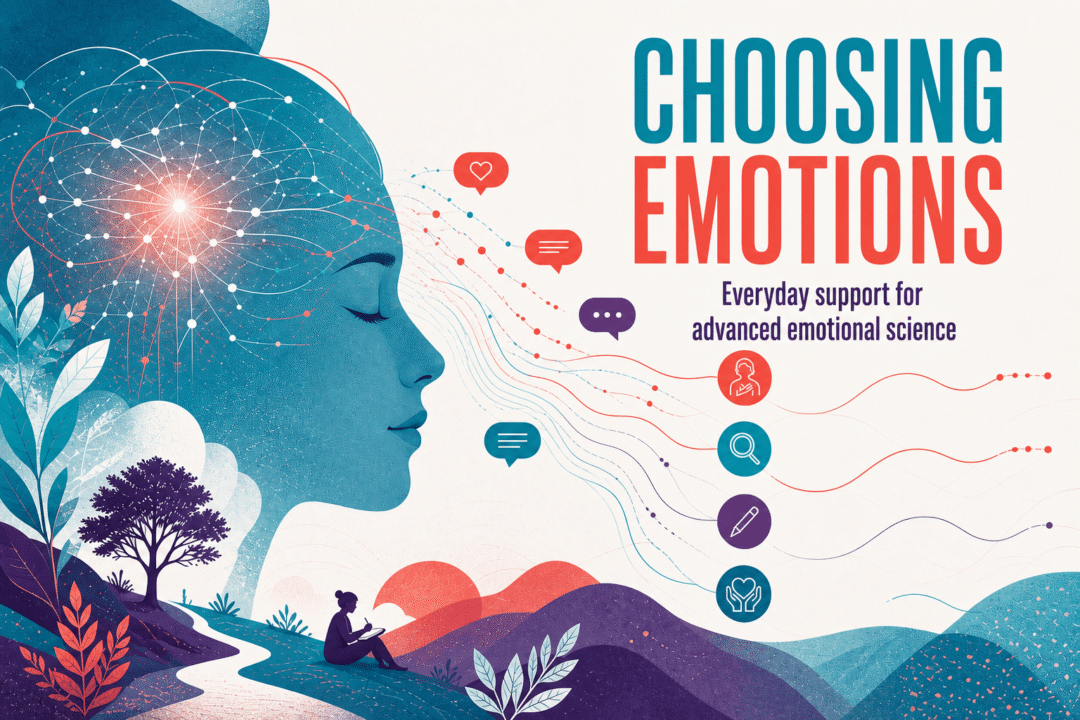
A Choosing Emotions Media Room White Paper
By D. Earl (“Doug”) Johnston — August 17, 2026
“I became interested in what happens when we put precise words to what we are feeling.
Over nine years I researched 8,000 phrases and quotes about 272 emotions
from 1,800 thinkers across 25 centuries. One of my conclusions is:”
Science measures life from the outside.
Emotions measure life from the inside.
Over the past two decades, a prominent group of researchers has built the scientific case for why naming emotions precisely matters. Dr. Matthew Lieberman (UCLA) pioneered affect labeling research, using clinical fMRI testing to show that putting feelings into words measurably calms the brain’s threat response. Building on that work, Dr. Daniel Siegel (UCLA) coined the now-famous phrase “Name it to tame it” — five words that have carried this finding into everyday language. Dr. Lisa Feldman Barrett (Northeastern) established emotional granularity: the more finely grained a person’s emotional vocabulary, the more precisely the brain can construct — and manage — emotional experience. And Dr. Ethan Kross (Michigan) has shown, through his research on self-distancing, that the specific words we use to talk to ourselves shape our ability to regulate our own emotions. Dr. James Pennebaker (University of Texas) adds a vital fifth area of coverage: his expressive-writing research shows that the specific words people use to describe an experience shape how fully they process and recover from it.
Choosing Emotions‘ “emotionary” format is unique and provides original field collection support for all five of these leading academic initiatives. It is a first-ever, ground-up catalog of the actual everyday words and phrases people use to describe their emotional experiences, functioning as a “go-by” to expand emotional command in the moment. The book answers two everyday questions: “How do I say it?” and “Are there other ways to express myself that feel best to me?” There is true relief — even joy — in being able to “nail it” when we communicate our thoughts with others.
This is the day-to-day dialogue, the middle ground between advanced science and daily life — where Barrett’s emotional granularity and Siegel’s name it to tame it are put directly into practice, through actual phrases and quotes from 1,800 thought leaders across every academic discipline and every walk of life. The 272 emotional entries are arranged alphabetically as supported by over 8,000 contributions and insights.
Sources
- Lieberman, M. D., Eisenberger, N. I., Crockett, M. J., Tom, S. M., Pfeifer, J. H., & Way, B. M. (2007). Putting feelings into words: Affect labeling disrupts amygdala activity in response to affective stimuli. Psychological Science, 18(5), 421–428.
- Siegel, D. J. — “Name it to tame it,” drawing on affect-labeling neuroscience including Lieberman et al. (2007). See also Siegel’s Brainstorm: The Power and Purpose of the Teenage Brain and related work.
- Barrett, L. F. (2017). How Emotions Are Made: The Secret Life of the Brain. Houghton Mifflin Harcourt.
- Kross, E. (2021). Chatter: The Voice in Our Head, Why It Matters, and How to Harness It. Crown.
- Pennebaker, J. W. — Expressive-writing research on how putting experience into words supports emotional processing and recovery. Opening Up by Writing It Down (with J. F. Evans) and related work.
- Johnston, D. E. (2025). Choosing Emotions: Thinking with Your Head and Acting with Your Heart. Western Gold Publishing.