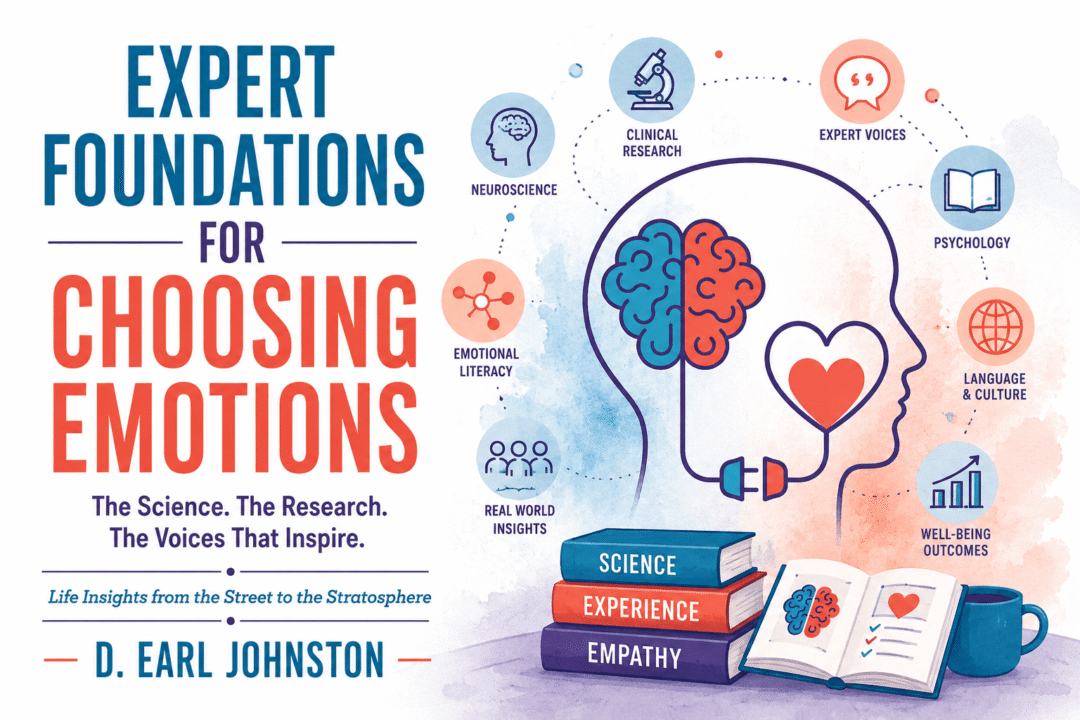
For decades, leading psychologists, neuroscientists, and advanced researchers have pointed to the same gap in our understanding of emotions. Emotional literacy is a cherished target, yet our everyday emotional vocabulary is often too shallow. We often still grasp for the right words, and most of us experience difficulty in describing how we feel. Naming our feelings with precision produces calm and relief, and putting words to emotions is a documented driver of well-being. What has been missing until now is an actual catalog of the subjective, heart-based terms and phrases to match what we are feeling – to help get unstuck and move forward. Choosing Emotions was built to fill this gap.
The nine scientists and thought leaders below, spanning seven fields of research, outline the academic foundations that support the book, and why a clear, accessible, and alphabetized ‘emotionary’ approach was needed. With 272 everyday emotions described by 8,000 quotes and phrases including insights and contributors from all walks of life, Choosing Emotions has now emerged as the most comprehensive reference book on emotions in the English language.
1. The Clinical Foundation: Dr. Lisa Feldman Barrett and Emotional Granularit
Leading neuroscientist Dr. Lisa Feldman Barrett has spent two decades building the scientific case for why vocabulary itself shapes emotional experience — the concept she calls “emotional granularity.”
Lisa Feldman Barrett, Ph.D. — Northeastern University (NYT bestselling author and neuroscientist; among the top 1% most-cited scientists in the world.) Dr. Barrett observed that “the more finely grained your vocabulary, the more precisely your brain can construct emotion,” and has pointed out that one of the easiest ways to build new emotion concepts is simply to learn new words. (How Emotions Are Made, 2017)
Barrett’s clinical research establishes the mechanism — why a richer vocabulary matters. This is the gap Choosing Emotions was built to close.
2. The Epochal Phrase: Dr. Daniel Siegel and “Name It to Tame It”
No single phrase in the field has traveled further than the one coined by Dr. Daniel Siegel — a five-word phrase for the ages which summarizes what naming an emotion actually does for the brain and body.
Daniel J. Siegel, MD — Clinical Professor of Psychiatry, UCLA School of Medicine; founding co-director of the Mindful Awareness Research Center at UCLA; multiple New York Times bestselling author (including Brainstorm: The Power and Purpose of the Teenage Brain). Drawing on affect-labeling neuroscience — including fMRI research showing that verbalizing emotions calms the amygdala and re-engages the prefrontal cortex — Siegel coined the now-epochal phrase “Name it to tame it,” the neuroscientific foundation at the center of Choosing Emotions.
Siegel’s work supplies the clinical proof for exactly what Choosing Emotions provides – easy and often enlightened answers for how to name your feelings precisely, and the benefits of the process.
3. Direct Precedent: Dr. Tim Lomas’ The Positive Lexicography Project
The clearest existing call for exactly this kind of cataloging of words and phrases comes from Dr. Tim Lomas, a positive psychology researcher formerly at the University of East London. His research explicitly set out to build a vocabulary of subjective emotional and well-being terms and single words which were lacking in English.
Tim Lomas, Ph.D. (University of East London) — Positive psychology researcher whose research interests include mindfulness, Buddhism, and “second wave” positive psychology. Dr. Lomas outlined the beginnings of a positive cross-cultural lexicography of ‘untranslatable’ words pertaining to well-being, culled from across the world’s languages, and through a quasi-systematic search — with the explicit goal of expanding readers’ emotional vocabulary and, in turn, their well-being. (Journal of Positive Psychology, 2016)
Lomas’s book, Translating Happiness, is the leading proof of a top researcher naming an exact need: that a deliberate catalog of subjective emotional language can meaningfully expand how people experience and understand their own well-being. His frame is cross-cultural. Choosing Emotions extends the same underlying instinct to everyday English, using heart-based phrasing, and expert description across 272 emotions.
4. The Psychology Today Case for Naming Emotions
Writing for Psychology Today, psychotherapist Dr. Katrina McCoy laid out, in plain and highly citable terms, why precise emotional naming matters.
Katrina McCoy, Ph.D. — Licensed psychotherapist with more than 10 years of experience as an educator, supervisor, and scholar in academic medical settings, including Harvard and Albert Einstein College of Medicine. McCoy wrote that finding more precise labels for our emotions (emotional granularity) is critical to wellness, and that we can cultivate this skill by expanding our vocabulary — noting that people who describe and label their emotions more specifically experience less severe episodes of anxiety and depression. (“Calling Emotions by Name,” Psychology Today, Oct. 10, 2023)
Her article also cites neuroscience showing that labeling emotions decreases activity in brain areas associated with negative emotion (Lieberman et al., 2007) — direct clinical support for the “name it to tame it” principle at the heart of Choosing Emotions, and a strong candidate for the Media Room given its recency, accessibility, and citation-rich structure.
5. Drs. Vine, Boyd, and Pennebaker on Natural Emotion Vocabularies
A 2020 Nature Communications paper confirms how little cataloging work has actually been done on how people naturally name their emotions.
Vera Vine, Ryan L. Boyd, and James W. Pennebaker, Ph.D. — Vine (University of Pittsburgh) led the study; Professor Pennebaker (University of Texas at Austin) is the senior author and pioneer of expressive-writing research and computational word-count analysis methods (LIWC). The team noted that despite widespread interest in naming emotions, researchers still know little about natural emotion word repertoires or how they relate to emotional functioning. (Nature Communications, 2020) This work acknowledges that the underlying field work had remained thin in cataloging the naming and phrasing of emotional experiences.
6. The Practical Precedent: Dr. Marc Brackett and the Mood Meter
Yale’s Marc Brackett built the most well-known practical tool aimed at the same underlying problem: people simply don’t have enough words for how they feel.
Marc Brackett, Ph.D. — Founding Director, Yale Center for Emotional Intelligence, and creator of the RULER emotional-literacy framework used in thousands of U.S. schools. Dr. Brackett observed that most of us have a fairly limited vocabulary when it comes to emotions — beyond “sad, glad, mad” many people default to “fine” — and he built the Mood Meter, a 100-word feeling-vocabulary grid, to address the issue. (Permission to Feel, 2019)
Brackett’s Mood Meter demonstrates the market for an expanded feeling vocabulary on a much smaller scale (100 single words on a grid) than Choosing Emotions, a vastly larger research work which pairs 272 emotions with 8,000 idiomatic, heart-based phrases, and expert quotes describing each emotion.
7. A Comparable Voice: Dr. Brené Brown and Atlas of the Heart
Among the above thought leaders, Dr. Brené Brown has come closest to attempting a comparable project — which makes her both a strong validating voice and likely the most useful work of direct comparison.
Brené Brown, Ph.D., MSW — [Research Professor, University of Houston (Huffington Foundation Endowed Chair); Professor of Practice, University of Texas at Austin McCombs School of Business; author of six #1 New York Times bestsellers, including Atlas of the Heart and Daring Greatly; her TED talk “The Power of Vulnerability” is among the five most-viewed TED talks ever, with more than 50 million views.] In Atlas of the Heart — her own mapping of 87 emotions and experiences — Brown wrote: “Language is our portal to meaning-making, connection, healing, learning, and self-awareness. Having access to the right words can open up entire universes.” (Atlas of the Heart, 2021)
Choosing Emotions went further. Where Atlas of the Heart maps 87 emotions and experiences through Brown’s research and storytelling, Choosing Emotions maps 272 emotions and emotional states — pairing each emotion with: 1) classic objective definitions, 2) popular subjective and heart-based phrasing, and 3) up to 25 directly relevant expert quotes drawn from 1,800 contributors across 2,500 years of recorded thought.
Choosing Emotions Fills the Gap the Above Voices Describe
Taken together, the leaders above describe a well-documented need for improved emotional literacy through better daily words and vocabulary; however, the vital supporting field work waited until now in Choosing Emotions:
- Barrett established the clinical ‘emotional granularity’ baseline case for why precise emotional language matters, and yet without producing a catalog of the specific words and language.
- Siegel gave the field its most memorable proof point — “Name it to tame it” — without building the vocabulary readers would need to do the naming.
- Lomas called for expanding emotional vocabulary through a systematic vocabulary, but often focused on less translatable and/or cross-cultural terms rather than everyday English words and phrases.
- McCoy reinforced the clinical case for naming emotions precisely, without producing a catalog of that language.
- Vine, Boyd, and Pennebaker confirmed the concept and that the field lacked solid data on natural emotion vocabularies.
- Brackett proved the appetite for expanded feeling vocabulary at the scale of 100 words on a grid.
- Brown’s Atlas of the Heart mapped just 87 emotions, using personal views, stories, and anecdotes as the nearest comparable book in the marketplace, but without the vital support of 8,000 cataloged terms, phrases, and quotes from 1,800 thought leaders from all walks of life.
Choosing Emotions is the first work to combine all of these threads into a single, comprehensive reference: 272 emotions, each defined through: 1) classic objective terms, 2) popular, subjective, heart-based phrasing, and 3) supported by up to 25 expert quotes per emotion, as drawn from 1,800 contributors across 2,500 years.
Epilogue
What is it that we human beings ultimately depend on? We depend on our words. We are suspended in language.
Note: quoted in Aage Petersen, “The Philosophy of Niels Bohr,” Bulletin of the Atomic Scientists, 1963.