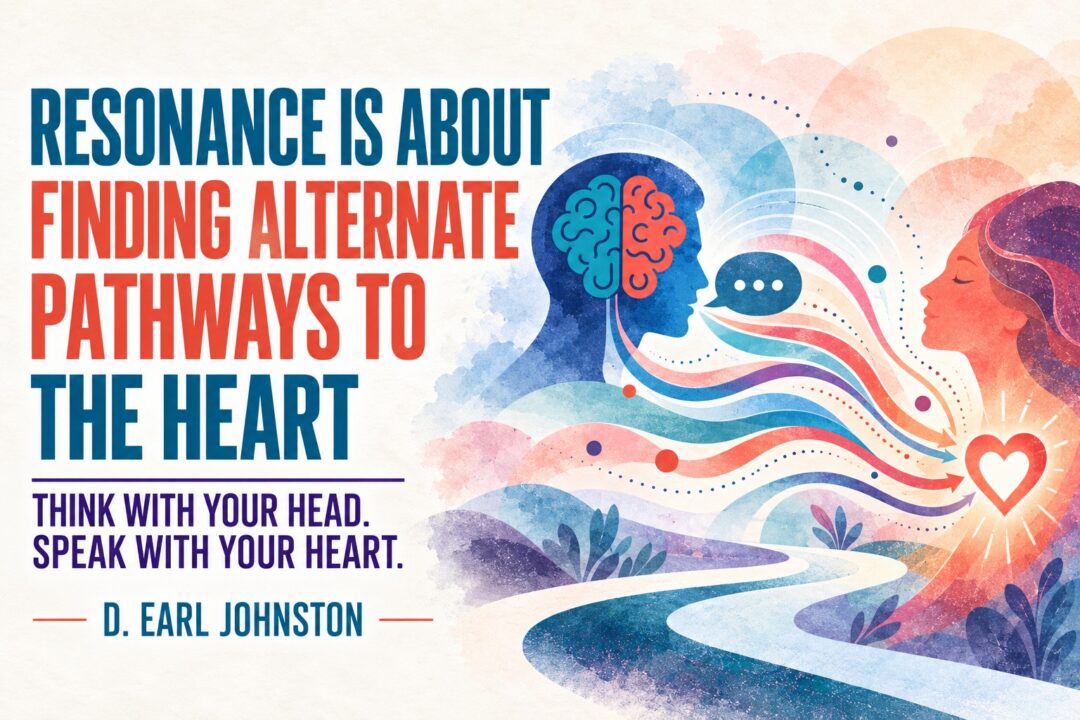
by D. Earl Johnston
From the moment we’re born, nobody hands us a user’s guide to emotions. We pick it up on the fly: from family, from friends, from our beliefs, from trial and error. We’re told to use our heads and follow our hearts — and then left, mostly on our own, to sort out which one should lead when it actually counts.
The navigation between head and heart shows up more plainly at the podium. As speakers, we’re taught to build a case — facts, structure, logic — and yet the moment that matters most in any speech is rarely the moment the audience is doing any arithmetic. It’s the moment they feel something. An audience may forget much of what you told them. What they will remember, almost without exception, is how you made them feel.
That’s what resonance really is. And it turns out the specific words and phrases we choose to land with an audience often matter more than the facts we deliver.
Two Ways of Knowing
Thought leaders across the arts and sciences have long described two different domains we move through as speakers and as people. One runs on facts, calculation, and intellect — call it the head. The other runs on feeling, intuition, and story — call it the heart. We shift between them constantly, and healthy living probably depends on both working together rather than one overruling the other.
But they aren’t equally impactful or lasting. We change our minds all the time — a new fact arrives, and we update. A change of heart is a different thing entirely. As the Houston-based writer and thinker Rev. Todd Stocker puts it, “A change of heart changes everything.” Minds get updated. Hearts get transformed. Speakers who understand the difference often aim to win the heart.
What Resonance Actually Feels Like
The dictionary defines resonance as a matching or appealing vibration — this is accurate, and yet can be more subconscious. A receptive audience is probably not thinking in terms of vibrations. They’re thinking, or half-consciously feeling, something closer to: What I’m hearing – that’s so me. The speaker is nailing it. We’re on the same wavelength.
Those aren’t descriptions of how resonance looks. They’re descriptions of how it feels from the inside — and that distinction is the whole game. A speaker connecting with resonance isn’t hunting for a better argument. They’re hunting for the term or phrase that helps the audience recognize its own feeling experience before the speech even draws to a conclusion.
Why the Right Phrase Does What the Right Fact Can’t
This isn’t a new idea — it’s one the arts and sciences have been converging on for a long time, from opposite directions arriving at the same place.
Daniel Siegel, the UCLA psychiatrist and bestselling author, gave us the phrase that’s become almost a household rule of thumb: Name it to tame it. Simply putting precise words to what we’re feeling — out loud, if possible — changes our relationship to that feeling. The thought stops being a fog or a question mark and starts being something we can actually look at and work with – and hopefully even an exclamation point. The same is true in reverse, from the podium: give an audience the precise phrase for what they’re already half-feeling, and you haven’t just described their experience. You’ve handed it back to them, named. They feel mentally at home.
Part of why certain phrases succeed where others don’t is the concept of compression. Our minds like brevity, and they like rhythm — a short phrase that compacts a whole emotional experience into a handful of words tends to outlast a paragraph that explains the same thing at length. Science measures life from the outside, while emotions measure life from the inside. Music has understood this, where Hall of Fame songwriter Harlan Howard describes: “Country music is three chords and the truth.” The record-setting duo of Hall & Oates have described the power of “universal intimacy” in their lyrics. Shakespeare understood this well four centuries before cognitive science caught up to explain why: “good riddance!” and “wearing your heart on your sleeve” and “to thine own self be true” are still doing work today, not so much because they were clever, but because they were compact enough to lodge somewhere and true enough to stay there. In our hearts.
The pattern has continued to evolve. Shakespeare’s memorable compression of complexity and overwhelm into the simple “it’s Greek to me” now has a modern counterpart in “wrapping your head around an idea.” We more easily substitute “pushback” in place of argument and countering. “High-five” moved into the Oxford English Dictionary within only a few short years — not because it was profound, but because it named something instantly recognizable in almost no words at all. The phrase quickly entered wide usage around the world. That’s the mechanism, whether the century is the 1600s or the present: a short, well-chosen phrase can reach an emotional home that is far more powerful than technical words can reach.
Researchers across neuroscience, psychology, and linguistics — Lisa Feldman Barrett’s work on emotional granularity, Ethan Kross’s research on self-distancing among them — keep arriving at versions of the same conclusion: precise language changes how we experience emotion, not just how we describe it. Literature and speechcraft have operated on that instinct for centuries. It’s worth knowing the heart-based instincts of Shakespeare now have real company in science.
Speaking to Land
None of this argues that facts don’t matter in a speech. They do — they’re the case you’re building, the reason anyone should believe you. But if the goal is resonance, the kind that makes an audience nod before they’ve finished parsing your sentence, the facts rarely get you there on their own. The specific emotional phrases you choose can readily help stick the landing.
So the next time you’re focused on delivering that moment — the one where the room goes quiet in the wonderful way it goes quiet when your idea has landed — the goal probably isn’t a sharper statistic. It’s a better-chosen word or phrase that matches a feeling that’s already sitting in the room, waiting for you to call it forward.
Think with your head. Speak with your heart.
____________________________________________________________________________________________________________________
Earl (“Doug”) Johnston is the author of Choosing Emotions: Thinking with Your Head and Acting with Your Heart, a comprehensive reference on emotions which covers 272 emotions through 8,000 phrases and quotes drawn from 1,800 contributors over 25 centuries and all walks of life.