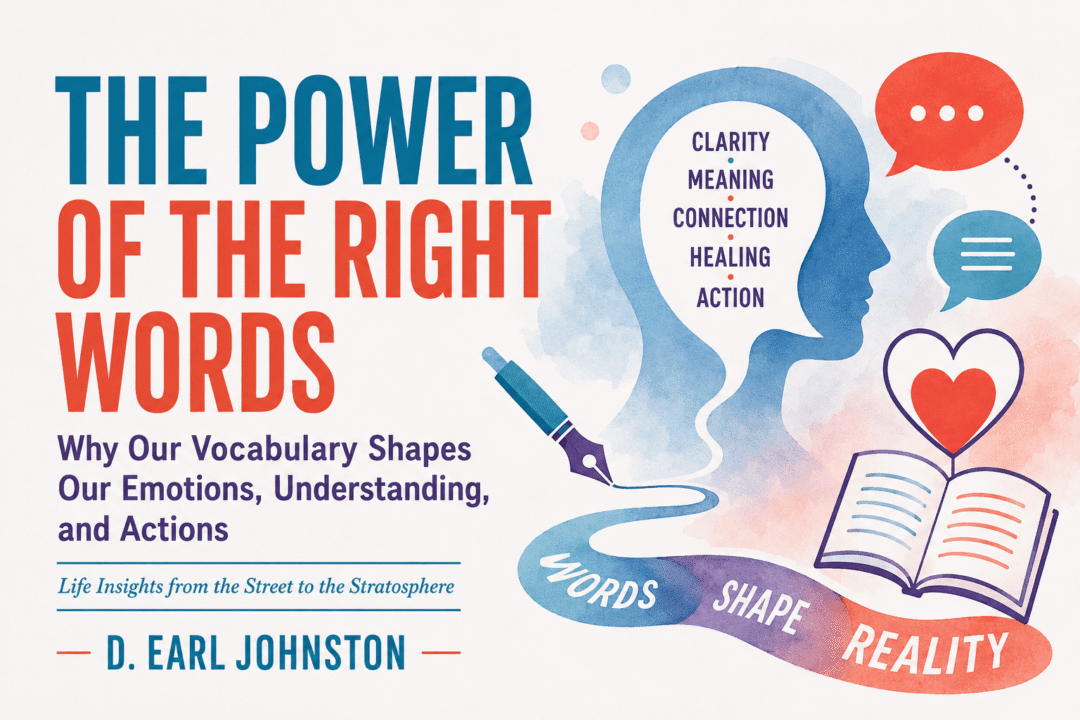
© D. Earl Johnston, 2026 Author, Choosing Emotions: Thinking with Your Head and Acting with Your Heart
Below is a consilience — a convergence of independent conclusions arrived at across nineteen disciplines and twenty-five centuries about the role of vocabulary in emotional experience. No single tradition, school, or century owns the conclusion. Each voice represents persistently shared observations across these multiple fields of human inquiry — with a common view now beyond hypothesis or debate – that our vocabulary determines our understanding and behavior. Emotional intelligence and emotional literacy are rooted in our words. This convergence of views supports that in the realm of emotions, which may represent the Rosetta Stone common to all disciplines and human behavior, the adequacy and precision of our words determine the quality of our experiences.
Consider who has led us here, and from where:
1) Physics
A theoretical physicist confronts the essential role of language in describing the basis of reality:
What is it that we human beings ultimately depend on? We depend on our words. We are suspended in language.
2) Philosophy of Language
A philosopher of language identifies the boundaries of the knowable:
The limits of my language are the limits of my world.
3) Engineering
An engineer undertakes problem-solving through the efficacy of language:
A problem well-stated is a problem half-solved.
4) Linguistics
A linguist describes the structural grip that language holds on cognition:
Language etches the grooves through which your thoughts must flow.
5) Clinical Psychiatry
A clinical psychiatrist distills decades of therapeutic practice into five words:
Name it to tame it.
6) Psychotraumatology, Trauma Studies
A medical doctor and trauma specialist describes the importance of words in resolving physical and emotional overwhelm:
All trauma is preverbal … While trauma keeps us dumbfounded, the path out of it is paved with words, carefully assembled, piece by piece, until the whole story can be revealed … The system is rooted in language.
7) Literature
The Father of Modern English Literature addresses the importance of matching words and behavior.
Suit the action to the word, and the word to the action.
8) Neuroscience
A neuroscientist and clinical psychologist explains why the brain requires fine-grained emotional vocabulary to function at its best:
The more finely grained your vocabulary, the more precisely your brain can construct emotion.
9) Psychology
Two leading psychologists identify language as the gateway to understanding and to healing:
The act of putting emotions into words allows the brain to organize experience, and that organization has measurable physiological consequences.
Language is our portal to meaning-making. Having access to the right words can open up entire universes.
10) Theology
Three of the world’s great faith traditions independently identify the word not as a descriptor of reality but as its Creator:
Judaism: “God said, ‘Let there be light’; and there was light.” — Genesis 1:3, Tanakh (Jewish Publication Society). The Hebrew word dabar (דָָּבְָר) carries simultaneously the meanings of word, deed, and thing — the creative act and the word that initiates it are a single term. This insight was carried forward most eloquently by Rabbi Abraham Joshua Heschel, whose formulation “words create worlds” is recognized across all branches of Judaism and in interfaith scholarship alike.
Christianity: “In the beginning was the Word, and the Word was with God, and the Word was God.” — John 1:1, King James Version. The Greek Logos — translated as The Word — was understood by early Christian theology as the generative principle of all Creation. The Word precedes and produces the world.
Islam: “Kun fayakun” — “Be, and it is.” Quran 2:117; 3:47; 36:82. The Quran’s repeated formulation of divine creation through the spoken command establishes that in Islam, as in Judaism and Christianity, the word is ontologically prior to the physical world it calls into being.
11) Buddhism
The Buddhist philosophical tradition produced the world’s first systematic taxonomy of mental and emotional states — the Abhidharma — cataloguing 51 distinct mental factors across Theravada and Mahayana schools, more than two thousand years before modern psychology. The premise was that a precise naming of inner states provides the foundation of practice, understanding, and liberation. A widely-read modern Buddhist, Thich Nhat Hanh — nominated for the Nobel Peace Prize by Martin Luther King Jr. — distilled this into a direct instruction:
Recognize and acknowledge the presence of these feelings. Don’t fight them or drive them out of your mind. Call them by their names.
12) Rhetoric
Two foundational voices of the Western rhetorical tradition — separated by four centuries — identify words as the primary instrument acting upon human emotion:
Speech is a powerful lord, which by means of the finest and most invisible body affects the divinest works: it can stop fear and banish grief and create joy and nurture pity.
To instruct is a duty; to please is an honor; to move is a necessity.
13) Anthropology
A leading linguist, lexicographer, and anthropologist identifies language not as a neutral medium but as the active shaper of perception and thought:
Human beings do not live in the objective world alone, nor alone in the world of social activity as ordinarily understood, but are very much at the mercy of the particular language which has become the medium of expression for their society.
14) Art
A genre-defining artist addresses the relevance of definition:
To define a thing is to substitute the definition for the thing itself.
15) Behavioral Economics
A psychologist and Nobel laureate in economics identifies the boundaries imposed by limited information and the necessity of plain language:
We can’t help dealing with the limited information we have as if it were all there is to know.
If you care about being thought credible and intelligent, do not use complex language where simple language will do.
16) Ethics & Moral Philosophy
Two voices from ethics and moral philosophy arrive from different directions at the same conclusion — that naming what we feel is not incidental to the moral life but central to it, and that the most demanding truths are best carried in the most common words:
Language is the light of the mind. The most important thing a man can know is what to call his feelings.
One should use common words to say uncommon things.
17) Philosophy of Mind
Regarded as the father of American psychology, James worked at the exact boundary between philosophy and psychology — identifying that inner attitudes, once changed, change everything that follows:
The greatest discovery of my generation is that a human being can alter his life by altering his attitudes.
18) Logic
A foundational philosopher identifies precision as a primary objective of education:
It is the mark of an educated man to look for precision in each class of things so far as its nature permits.
19) Philosophy
And finally, among the oldest Western voices in this group — whose works have had two and a half millennia to be assessed:
He who can properly define and divide is to be considered a god.
Nineteen disciplines. Nineteen confirming views. A span of twenty-five centuries. The convergence was organic and not orchestrated. With notable independence across ages and cultures which separated a theoretical physicist from an ancient Greek philosopher, a poet and dramatist from a cubist painter, a neuroscientist from an engineer, a trauma specialist from a theologian, and a Buddhist monk from a Roman orator, each expert voice nonetheless arrived in agreement that better words are essential to better outcomes.
Choosing Emotions was developed on this understanding. The book examines 272 emotions and emotional states through 8,000 phenomenological phrases, insights, and quotes from thought leaders and contributors from all walks of life over 25 centuries. The book represents one of the most comprehensive references on emotions in the English language, and it provides an innovative lexicographic architecture of emotional states that gives the reader more instruments, more finely calibrated, than have been provided before. Where Barrett notes that a finer-grained vocabulary allows the brain to construct emotions more precisely, then what follows is not merely an expansion of catalogue. It is clarification that what we are capable of experiencing and choosing is dependent upon our awareness, knowledge, and assignment of words. Van der Kolk’s findings underscore that even in the extreme environments of trauma and overwhelm, words provide us the pathway out of distress.
Plato framed the importance of words, and the convergence across the centuries has been re-confirmed. The adequacy and precision of our words determine the quality of our experiences.
© 2026 D. Earl Johnston
www.choosingemotions.com
July 29, 2026
Epilogue – The Limits of Physics and Knowledge
Separately, the Founder of Classical Physics reviews the boundaries between Physics and Metaphysics as first noted by Aristotle:
Gravity explains the motions of the planets, but it cannot explain who set the planets in motion.