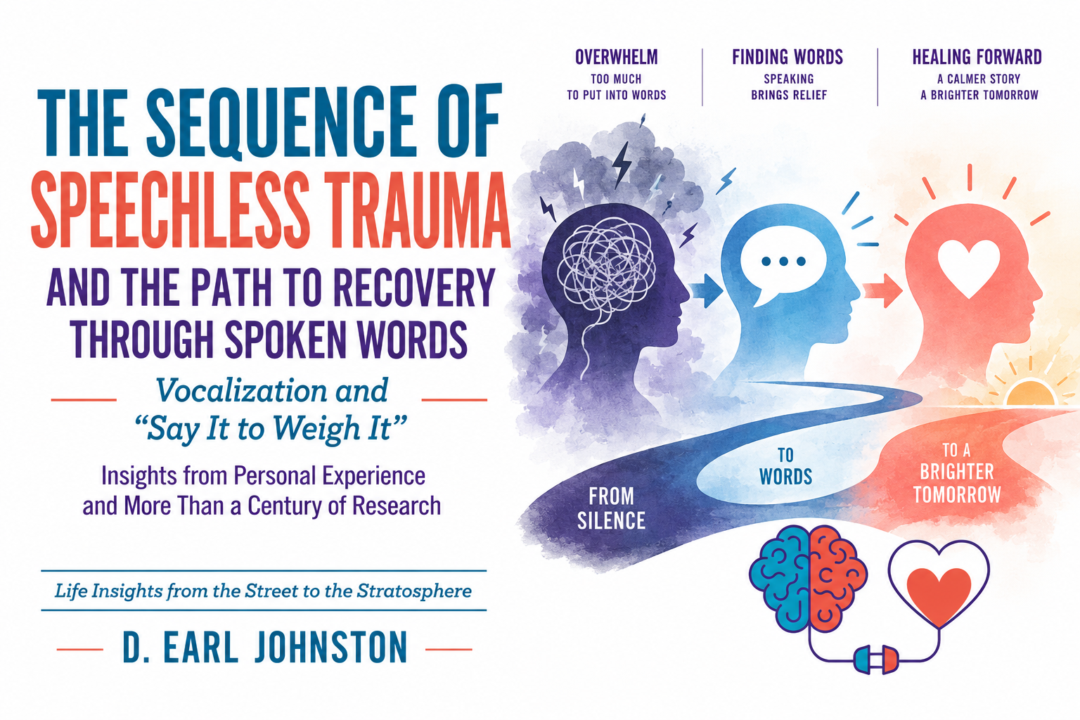
By D. Earl (“Doug”) Johnston | September 17, 2026
“Trauma represents a catastrophic rupture in vocabulary.
We can be overwhelmed beyond words. Relief emerges when
we put words to what happened.”
— D. Earl Johnston
Purpose of This Paper
This paper builds on Choosing Emotions Research Notes No. 1 (“Trauma as Emotional ‘Tilt’: Observations and Model, Synthesized Against 130 Years of Clinical Research”) by tracing a specific sequence. That sequence runs from the moment of overwhelming trauma (emotional and/or physical), through partial and/or full speechlessness, the emotional system’s priority coding of its own failure to protect, and the associated repetition compulsion, to the approach-avoidance paralysis paradox this produces. It concludes with the recognition that putting words to the ‘gap’ trauma experience and speaking the experience aloud — once the phenomenon is understood — helps to facilitate recovery from trauma. Each step in the sequence is presented below against cited support in academic literature, in the interest of demonstrating that a synthesis arrived at independently by the author, through both decades of personal lived experience with trauma and ten years of research, ties together the research across multiple academic fields. By identifying and integrating the overlaps between often-siloed disciplines, the author notes the convergence of more than a century of established academic research across neuroscience, learning theory, and trauma studies, and also extending into philosophy, theology, and the arts.
Author’s Note: Genesis of This Synthesis
This sequence was not built from the literature outward. It was lived personally first, articulated in both identified traumatic experiences and subsequent conversations over many years, and only afterward was checked by the author against the research record.
Concretely, this sequence draws on three of the author’s own traumatic episodes, among others, spanning childhood into adolescence. At age nine, the author was struck by a car while running across a rain-slicked parking lot — an accident of his own doing — and was hospitalized for weeks as a result. At seventeen, a collision with a goalpost during a soccer game left the author unconscious; he was later taken to the hospital, where a cracked skull was discovered. The second episode is, in a literal sense, the far end of van der Kolk’s “preverbal” — there was no initial verbal record of the event as a result of the sudden collision and immediate unconsciousness. At thirteen, the author woke in the night to the shocking discovery that his parents’ marriage was not what he had believed it to be — a discovery that reordered a foundational assumption about his nuclear family and which was followed by decades of estrangement. Reconciliation through extensive dialogue came before his mother’s death in early 2026, and the author delivered a eulogy in thoughtful terms before an audience of over two hundred. That traumatic arc — overwhelm and speechlessness, followed by years of avoidance, and eventually addressed by conscious integration and an articulated framing in spoken words — is itself a lived demonstration of this paper’s own Step 9 and 9a. Beyond personal experience and recovery, a key post-cycle research discovery emerged from a specific observation from Bessel van der Kolk — “all trauma is preverbal” (van der Kolk, 2014; page varies by edition) — offered in the multi-year bestseller The Body Keeps the Score, and the author’s recognition that this underappreciated sentence carries far-reaching implications once followed to their conclusion. What follows is the verbatim record of the author’s initial observations, from which the sequence of traumatic episode and recovery was identified, developed, and documented here.
Author’s Issue-Framing Query at 8-31-26 — Verbatim (with added explanatory notes)
“Whether he (Bessel van der Kolk, MD in The Body Keeps the Score) meant it clinically or flatly (re: “All trauma is preverbal”) he said it and it has far-ranging implications. Trauma is overwhelm — literally the person is speechless. I have been there and struggled for decades to face it. And finally did. I found the words and/or created them to build a context to help me understand what had happened. But the ‘facing it’ difficulty that people have after-the-fact is a slightly different issue from the moment of trauma. If I am right (and it appears so) that trauma is usually so unexpected and sudden that we simply cannot articulate it. Too much data = ‘tilt.’ But the emotional system’s #1 is to protect (Before #2 advance) so the emotional system ‘codes’ the issue at the highest priority because it failed to protect. And this is repetition compulsion. But the initial overwhelming event is different from the repetition compulsion aftermath and they are both distorted by a ‘command’ to ‘avoid this scene don’t go here again because you were hurt this way the first time.’ So it becomes ‘forcing’ yourself to face what happened. But that process is far easier AS SOON AS YOU KNOW THAT YOUR EMOTIONAL SYSTEM WAS ALWAYS JUST TRYING TO PROTECT YOU. It is easier to speak aloud and find the words when you know the ‘why.’”
“A lifetime to get here. I literally would not allow myself even to look at something the repetition compulsion told me daily I had to see. I think the pieces all fit, and it is no real surprise to me that it is corroborated. Real material. Viewed in a cross-disciplinary way, as it should be. With the importance of speaking it aloud ascendant and re-validated.”
Part One: The Sequence and Its Literature
1. Overwhelm
A traumatic event exceeds the nervous system’s real-time capacity to process information, either fully or in part. The trauma may be emotional and/or physical. Research Note No. 1 framed the extreme case as emotional ‘tilt’ — an overload state analogous to a pinball machine’s tilt mechanism, in which too much input arrives too quickly for the system to register in an organized way. The system blinks and may shut down. But human emotional reset is more complex than an electronic reset for a pinball machine. There are still problematic ‘gaps’ in memory and/or consciousness to be addressed by the trauma victim.
2. Literal Speechlessness
The research indicates the overwhelm is not merely subjective; it is measurable. Van der Kolk’s own neuroimaging research found that Broca’s area — the brain’s speech-production center — shows reduced activity during a traumatic flashback, while the amygdala shows heightened activity (Rauch, van der Kolk, et al., 1996; van der Kolk, 2014). The person is, in a literal neurological sense, unable to produce a verbal account of what is happening while it is happening. Separately, Stephen Porges’s polyvagal theory identifies a freeze/shutdown response as a third autonomic option beyond fight or flight, engaged when the threat is perceived as inescapable (Porges, 2011) — a state that has no language attached to it, because the victim is overwhelmed and meaning-making language processes are operating sub-optimally during the episode.
3. The Emotional System’s Failure to Protect
Choosing Emotions’ own two-function model holds that the emotional system’s first priority is to protect us, and its second priority is to help advance our lives. When traumatic overwhelm occurs, protection has, by definition, failed. Fear-memory research indicates that threat memories associated with a failed protective response are encoded with unusually high salience in the amygdala — the system’s apparent correction for having missed the signal the first time (LeDoux, 1996). The traumatic event is not filed as one memory among many or as a simple blank or gap in memory; it is filed as urgent, unfinished business.
4. Repetition Compulsion
This urgent, high-salience coding produces what Freud first termed repetition compulsion — an unconscious tendency to return to, re-enact, or be drawn back toward the unresolved threat, as though some part of the system is still trying to finish the job of protecting the person the first time. Both Judith Herman (1992) and van der Kolk (2014) retain and apply this concept in modern trauma treatment, independently of its psychoanalytic origin.
5. “Can’t Look But Must Look”: The Paradoxical Avoidance Commands
The felt experience of being simultaneously compelled toward and repelled from the traumatic material has a well-established learning-theory basis. Mowrer’s two-factor theory (1947) explains how a fear response, once classically conditioned to a stimulus, becomes maintained by avoidance behavior that is reinforced simply because it reduces fear in the moment — regardless of whether the original threat is still present. This is precisely why avoidance is listed as a core diagnostic symptom cluster for PTSD: the avoidance is not incidental to the disorder, it is a self-reinforcing feature of it. The internal “command” to avoid the scene is not irrational; it is a conditioned response doing exactly what conditioned avoidance responses do. In day-to-day terms, a trauma sufferer can: (1) deny ongoing issues and yet be quietly fixated upon them, or (2) appear to others as outwardly fixated or obsessed with having been victimized.
6. The “Enemy” Was Trying to Protect You
The reframe that unlocks the ‘can’t look but must look’ avoidance paradox — that is, recognizing the avoidance command as a protective effort rather than a personal failing or a hostile force — is supported by self-compassion research. The emotional system’s highest duty is to protect us, and it can fixate on the ‘gap’ event until it resolves it – even to the point of presenting the gap event endlessly until we sort it out. Kristin Neff’s work demonstrates that self-criticism and shame around one’s own coping responses impede emotional processing, while self-compassionate reframing measurably improves a person’s capacity to approach difficult material (Neff, 2003). Judith Herman’s phased treatment model formalizes this same insight clinically: safety must be established, and the survivor’s own protective structure respected and understood, before the second phase — remembrance and mourning — can proceed (Herman, 1992).
7. Taking It Out of the Silent Inner Voice
Ethan Kross’s self-distancing research confirms and reinforces the author’s own experience and phrasing that shifting a difficult experience from an immersed, first-person perspective of emotion (being “in it”) to a more distanced, observer perspective (looking “at it”) reduces emotional intensity and improves objective reasoning about the experience (Kross & Ayduk, 2010; Mischkowski, Kross & Bushman, 2012). Speaking a feeling aloud — moving it out of the silent inner voice and into audible words — is one of the most direct and available ways to introduce this shift and benefit. Saying aloud what has been carried — often in the silent internal ‘loop’ of thought — adds objectivity to bring more balance to the emotional system’s inherent negativity bias. Among many similar views, Kahneman has noted this phenomenon as: “The brains of humans and other animals contain a mechanism that is designed to give priority to bad news” (Kahneman, 2011; Ch. 28, “Bad Events,” p. 301 in the Farrar, Straus and Giroux hardcover first edition). Speaking our doubts and concerns and views aloud can better bring the silent internal playing field into full conscious view after our inherent negativity bias has tilted the landscape. Stated simply, and as many find in day-to-day living, many/most of the things we worry about never happen, and we can find relief simply by speaking our concerns out loud to weigh their validity.
8. “Say It to Weigh It” Vocalization
Here the author introduces a new self-help awareness tool in helping to initiate recovery from trauma. By vocally expressing our silent inner emotional concerns, the vocalization brings focus and consciousness to the issue. Our inner voice can be chronically underexamined and yet these ‘inner loop’ concerns are often accepted as true. By putting words to them and saying them aloud, we can weigh them and assess them more objectively. We move closer to being at cause rather than being the effect of repetitive unexamined concerns and what-ifs. Pennebaker’s expressive-writing research shows that increasing use of causal and insight words over the course of processing a difficult experience tracks with improved health and cognitive outcomes (Pennebaker, 1997). Lieberman et al.’s affect-labeling research (2007 and 2011) demonstrates that simply naming an emotion — without judgment or elaboration — calms the amygdala and engages the prefrontal cortex, which is the neurological basis for Siegel’s epic “Name it to tame it.” Herman’s own language — “the conflict between the will to deny horrible events and the will to proclaim them aloud is the central dialectic of psychological trauma” (Herman, 1992, p. 1, Basic Books first edition) — places spoken proclamation, not merely silent recognition, at the center of the trauma process. This concept is independently reinforced across the literary and theological record as well: the Hebrew dabar, the Greek logos, and the Quranic kun fa-yakūn all treat the spoken word as generative and creative rather than merely descriptive. The Book of Psalms (see Choosing Emotions’ companion note, Scripture and the Speaking of Affliction) also models the spoken complaint (Psalm 130:1, “Out of the depths I cry to you, O Lord” and Psalm 142:2, “I pour out my complaint before him; I tell my trouble before him,” NRSVue) as a first act of relief; and Audre Lorde’s declaration that “my silences had not protected me” (Lorde, 1984, p. 41, Crossing Press edition) captures, from both a literary and political register, the same claim made clinically by Herman. Separately, in the Zen Buddhist philosophical tradition, one of the most influential Buddhist leaders of the past seventy years, Vietnamese-born Thich Nhat Hanh (the “Father of Mindfulness,” author of over 130 books, lecturer at Columbia, and nominated for the Nobel Peace Prize by Martin Luther King, Jr.) addressed emotions as: “Recognize and acknowledge the presence of these feelings. Don’t fight them or drive them out of your mind. Call them by their names” (Nhat Hanh, 2001). Daniel Siegel deserves explicit credit here for his own synthesis and summary. It was Siegel who coined, and through his own writing and public teaching popularized, “Name it to tame it” as a practical guidance built on this same mechanism (Siegel & Bryson, 2011; Siegel, 2010). The phrase itself is Siegel’s; the fMRI neuroimaging evidence for why it works is Lieberman et al.’s (2007 and 2011), not Siegel’s — a distinction worth preserving rather than collapsing the aphorism and the research into a single credit. Naming the feeling is the first step and naming it precisely it is the next step as we move toward relief.
8a. Precision Enhances the Relief
Not any words will do; the more precisely a word matches the affected (or ‘felt’) state, the more likely the relief. Lisa Feldman Barrett’s theory of constructed emotion holds that the brain builds — not merely labels — emotional experience from the concepts available to it: “the more finely grained your vocabulary, the more precisely your predicting brain can calibrate your budget to your body’s needs” (Barrett, 2017; p.181). Tim Lomas’s Positive Lexicography Project supplies converging evidence from the opposite direction: emotional states that lack a word in a given language remain, in Lomas’s phrase, an “unconceptualized ripple” in experience — available to be felt, but not to be grasped, examined, or spoken (Lomas, 2016). Brene Brown’s many bestselling successes in her wildly-popular psychology series add her own observations: “Language is our portal to meaning-making, connection, healing, learning, and self-awareness. Having access to the right words can open up entire universes.” (Brown, 2021; quoted from the Introduction to Atlas of the Heart, p. xxi) Together they suggest that Step 8’s vocalization does its full work only when the vocabulary reaches for precision rather than settling for the nearest generic word — which is also why this paper’s own Addendum already addresses Barrett’s granular vocabulary as a powerful advancement tool toward understanding and relief.
9. Recovery
Herman’s phased model concludes not merely with symptom reduction but with reconnection — the survivor’s return to ordinary life with the traumatic material integrated into a coherent narrative rather than held apart from it (Herman, 1992). Tedeschi and Calhoun’s research on posttraumatic growth goes a step further, documenting that a meaningful subset of trauma survivors report genuine positive change — increased personal strength, deepened relationships, a richer appreciation of life — arising specifically from the struggle to integrate and narrate what happened, not despite it (Tedeschi & Calhoun, 1996). Recovery, on this model, is not the absence of the memory but the presence of a conscious, spoken account of it.
9a. Recovery Reduces Fear through a Coherent Narrative
Recovery through spoken words does more than integrate the traumatic memory into a coherent narrative — it serves to expand and to fill in more completely what the memory carries. The ‘gap’ traumatic event, once acknowledged and more adequately put into words, no longer needs to be held as a live threat; the fear and/or mis-emotion that was originally attached to it — the emotional system’s own protective over-coding, described in Steps 3 and 4 above — can be substantially cleared from the memory once it has been named and spoken aloud. What remains afterward is not erasure, but a reduction in kind: the episode can re-settle into memory as merely unpleasant rather than fearsome, recalled without the ongoing alarm that once accompanied it. This is a different outcome than forgetting, and a different outcome than mere symptom management — it is the emotional system in resolution and standing down from a threat that spoken words have shown it no longer needs to guard against.
Part Two: Qualifications
-
This sequence describes a general pattern observed in research literature and corroborated by lived experience; it is not a diagnostic or clinical protocol, and it does not claim that every person’s trauma follows every step in this order or at this pace.
-
Repetition compulsion, avoidance learning, self-compassion, self-distancing, affect labeling, and posttraumatic growth are all well-established, independently authored concepts. This paper’s original contribution is the specific sequential synthesis connecting them — not the discovery of any individual mechanism within it.
-
As the Author’s Note states plainly, this synthesis was built from a single case first — the author’s own decades of lived experience — and only afterward checked against the literature. It is offered as a candidate framework for others to test against their own experience and against clinical data, not as a claim already validated at scale.
-
Nothing in this paper should be read as a substitute for professional trauma treatment. Herman’s own phased model exists precisely because unguided exposure to traumatic material, attempted before safety is established, can retraumatize rather than heal. Readers working through significant trauma are encouraged to seek a qualified clinician, ideally one experienced in trauma-specific modalities (e.g., EMDR, somatic therapies, or trauma-focused cognitive behavioral therapy).
-
Van der Kolk’s “all trauma is preverbal” is best read as a description of encoding at the moment of overwhelm, not as a claim that trauma can never be verbalized afterward — the entire arc of this paper, and the author’s own experience is evidence that it can, and that ‘Say it to Weigh It’ provides a first step toward replacing the initial speechlessness of trauma with more adequately putting words to the emotions and memories, and toward therapeutic and reframing speech and recovery.
Part Three: Overall Assessment
The value of this review is not that any single link is new — each is independently documented, in many cases for decades. The value arises in the progression of linkages: showing that overwhelm, speechlessness, protective mis-coding, repetition compulsion, avoidance, reframing, vocalization, and recovery form one continuous, mechanistically coherent process, rather than a loose collection of separately named phenomena. Viewed this way, Choosing Emotions’ own two-function emotional system model (protect before advance) supplies the organizing logic that the individual pieces of trauma literature do not, on their own, provide: protection that succeeds quietly steps aside; protection that fails gets coded so strongly that it can block advancement indefinitely — until the trauma victim understands that the block was never the enemy, only a zealous protective guard still standing post.
Addendum on Trauma Relief: Three-Point Review, and Now Adding Vocalization
This analysis provides a three-part focus on trauma: trauma as preverbal (partial or full wordlessness in the initial phases of overwhelm, as per van der Kolk); it adds Siegel’s epic “Name it to tame it” relief tool (including similar perspectives across multiple fields); and, separately, the critical importance of vocabulary and granularity (putting specific words to feelings — per Barrett and others). This paper further examines “Say It to Weigh It” and vocalization as an additional therapeutic tool in trauma relief.
August 31, 2026 — the date this sequence was fully articulated in conversation — is recorded elsewhere in the Choosing Emotions Media Room as “Say It to Weigh It Day.”